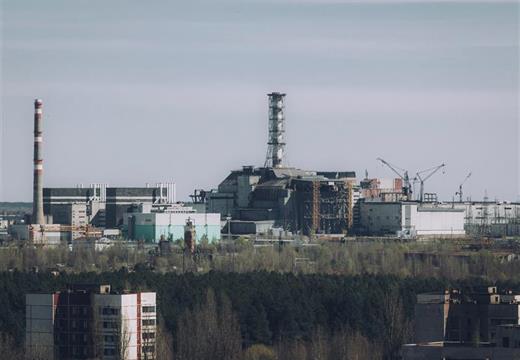
36 Years after the Chernobyl disaster: Nuclear power is and remains a high risk. We call for faster deployment of renewable energy!
Today, Tuesday 26 April marks the 36th anniversary of the Chernobyl disaster where a nuclear accident occurred in the reactor of the Nuclear Power Plant in the city of Pripyat, in the North of Ukraine, close to the Belarussian border. Together with the 2011 Fukushima nuclear disaster, it is considered the worst nuclear disaster in history, rated at the maximum severity on the international nuclear event scale. The Russian war against Ukraine has increased the potential danger since the aggressor’s military seriously threatened the Chernobyl site and the Zaporizhzhia Nuclear Power Plant in the South-East of Ukraine, which is the largest nuclear power plant in Europe.
In the context of the war in Ukraine and its impact on energy supply and security, there are more decisions, for example Belgium decided to prolong the duration of two existing power plants, which were planned to be shut down in the coming years, in Germany there are voices calling for such prolongations as well, and the French President announced to invest in the construction of new power plants.
Therefore, the decision of the European Commission on the classification of sustainable investments is becoming even more important as it is not only a question of financing, but even more a question of health and safety, and in particular of future generations.
Furthermore, nuclear power plants especially in Central and Eastern Europe depend often on Russia for the supply of raw material such as uranium and for the disposal of their nuclear waste. This increases the dependency on this country, on which many Western countries have put in force sanctions. Excluding these activities from the sanctions would undermine the political pressure on the aggressor and the credibility of the EU Member States concerned by continuing to finance the war.
We, the Greens in the Committee of the Regions, reiterate our strong opposition to the inclusion of nuclear power in the Taxonomy regulation and call for more and massive investment in renewable energy, as expressed in our declaration from December 2021:
Promoting nuclear power as a way to ensure energy supply and to fight climate change is at odds with a safe, climate-friendly, low-risk and sustainable EU energy policy, which is a substantial part of the European Green Deal.
Nuclear power is not sustainable for the following reasons:
- The operation of nuclear power plants involves risks that can make entire European regions and countries uninhabitable.
- Radioactive waste has to be safely stored for 1 million years. Today, more than half a century since the start of nuclear energy generation, no country in the world has established a repository for high-level radioactive waste. It is therefore an infinite burden for municipalities, regions and future generations.
- Nuclear power plants are very expensive and follow-up costs cause not least a high burden on direct and indirect public funds. Nuclear energy therefore falsely appears affordable, while it is financed with considerable amounts of taxpayers’ money.
- Existing installations are not technically state-of-the-art and require huge investments to improve their safety. These investment needs have been identified by the European Fukushima stress test. Therefore, the lifetime of existing nuclear power plants should be capped.
- New types of reactors claimed to have very low risks – such as the 4th reactors generation, Small Modular Reactors (SMR) or Transmutation Reactors – so far have only been announced and are far from industrial deployment. Relying on them is multiplying the risk and is delaying the transition to 100% renewable energy. The ideas consume research funding, which would be needed for the development of truly sustainable technology.
- Nuclear power stations, even of a next generation, cannot be used globally for climate protection, as they always carry the risk of proliferation of weapons-capable technology and fossile material. Yet, the technology on which the European Green Deal relies, must be globally applicable and cannot be reserved exclusively to some countries.
- Uranium extraction and nuclear fuel chains cause environmental damage, bear massive health risks and lead to dependencies on imported energy raw materials.
- Nuclear energy is at odds with the do no harm principle.
Already today, nuclear energy is no longer competitive with renewable energy. Renewable energy is available and much more inexpensive. Focussing investments of the equivalent sums in the production and storage of renewable energy is the precondition to make Europe climate neutral and to limiting temperature rise to 1.5°C.
Therefore, for the sake of the safety of future generations we call for:
NO SUPPORT AND A STOP TO GREENWASHING OF NUCLEAR POWERAND FORFASTER ROLL-OUT OF RENEWABLE ENERGY AND THEIR TECHNOLOGIES NOW