Championing Local Action for Global Climate Solutions
The 28th session of the Conference of Parties to the United Nations Framework Convention on Climate Change (COP28) concluded in Dubai on 13th December, marking a significant step forward in the global fight against climate change. In the midst of the urgent need to address the escalating climate crisis, Niina Ratilainen, the co-president of the Greens in the Committee of the Regions, advocated for the pivotal role of cities and regions in shaping the world’s response to climate challenges as part of the European Committee of the Regions’ (CoR) delegation.
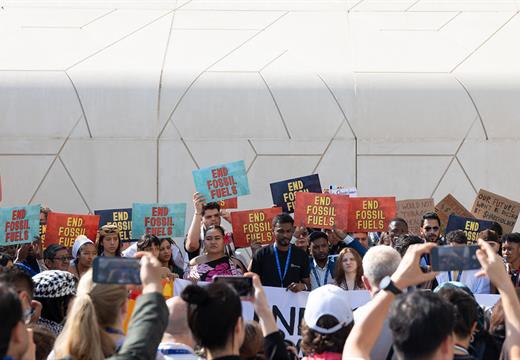
COP28 concluded with a historic breakthrough as negotiators incorporated a call for the first-ever transition away from fossil fuels into the final outcome document. This marks a pivotal moment in global efforts, demonstrating a clear commitment to the 1.5-degree target. While this sets a course for the phaseout of oil, coal, and gas in energy systems by 2050, the outcome could have been more robust. Lingering questions persist regarding how to ensure a just and well-funded transition grounded in science and equity. Following this decision, Europe needs to lead by example and achieve a full fossil fuel-phase out well ahead of 2050 to meet the broader global goal.
Furthermore, numerous cities, towns and regions globally have taken decisive actions to eliminate fossil fuels, addressing the primary human contribution to the climate crisis, air pollution and environmental damage. All levels of government are urged to expedite fossil fuel phase-out to attain a fossil-free energy mix as soon as possible.
Key achievements at COP28 reflect a growing acknowledgment of the crucial role of subnational entities. The agreement on a Loss and Damage Fund with direct financing to the most affected local and regional communities is a key milestone. Ratilainen emphasised the European responsibility to support regions most affected by the crisis, recognising the daily toll the climate crisis takes. “Our job is to finance that change, our job is to support. We try to live together on this planet,” she affirms.
The first-ever Local Climate Action Summit, and the launch of the Coalition for High Ambition Multilevel Partnerships (CHAMP) were also important in recognising the roles of local and regional authorities. CHAMP, endorsed by 70+ countries, commits to involving local and regional governments in the planning and implementation of climate policies, including the nationally determined contributions (NDCs). As the next round of NDCs approaches in 2025, it is imperative for these promises to translate into tangible actions by national governments.
The Global Stocktake outcome report, a comprehensive evaluation of progress since the Paris agreement, underscores the critical need for deep, rapid, and sustained reductions in greenhouse gas emissions to ensure the world’s heating is restricted to below 1.5°C, as set out by the Paris Agreement. The final deal also recognises the role of multilevel climate action and seeks to apply principles of CHAMP.
The Global Goal on Adaptation also recognises strengthened and inclusive governance as crucial elements for enabling adaptation actions. However, it falls short in addressing the specific financial needs required to empower local and subnational governments who are facing the impacts first-hand, along with coordinated mechanisms with national governments.
Cities and regions, continue their unwavering commitment to climate action, working tirelessly to achieve climate neutrality well ahead of global, European, or national targets. The expectation is clear: the European Union must persist in pushing for increased involvement of cities and regions, aligning with its negotiation mandate for COP.
Ratilainen also emphasises the importance of local climate conferences, allowing citizens to influence local solutions to a global issue. Local levels, she argues, serve as test beds for successful projects ready for scaling up.