Cities and regions ready for the mobility transition
Urban mobility is a key topic for the Greens in the CoR as it covers a multitude of issues such as use of public space, allocation of public funding and safety for the road users. Transport modes have different impacts on the environment, the climate, public health and our societies and therefore, the Greens promote public transport, walking and cycling.
On 11 October 2022, the CoR Plenary adopted its opinion on the new EU Framework for Urban Mobility, drafted by Linda Gaasch, member of the Greens in the CoR and of the Luxembourg City municipal council.
The opinion highlights the need for strengthened and coordinated support from public authorities in order to achieve a significant modal shift towards public and active transport modes, such as walking and cycling. Currently, the most polluting transport modes in cities occupy the largest part of public space dedicated to mobility, and public transport infrastructure has been chronically underfunded over the last decades. Therefore, local authorities need sufficient financial means, including from the EU. For example, revenue from CO2 taxes should be channelled into rail or cycling networks and other sustainable infrastructure projects.
Linda Gaasch was optimistic about the mobility transition: “with the opinion on the Urban Mobility Framework, the European Committee of the Regions sends a strong signal to the other European institutions: cities and regions are ready for the mobility transition!”.
In the preparation of her opinion, Linda was supported by Philipp Cerny, chief author of the European Mobility Atlas.
During the same week, in the context of the European Week of Regions and Cities, the Greens in the CoR organised a workshop to explore inclusive approaches of designing and implementing urban mobility to serve all residents of a city. The workshop was moderated by Linda Gaasch, the Greens’ rapporteur on urban mobility.
Janet Horner, City Councillor in Dublin, talked about women and mobility, sharing information from her city where they discovered that only 10% of children cycling to school were girls, although some improvements have been seen in the last years. For women, sense of safety and security is a priority when using public transport, cycling and walking. Janet Horner highlighted how having children is the moment when women in particular feel they need to have a car, since the Dublin public transport system does not facilitate their more complicated mobility patterns with children. It was concluded that women are good indicators for an inclusive city.
Kamil Goungor, policy and movement support officer of the European network for independent living, contributed with his personal experience getting around and travelling in a wheel chair, unsuccessfully trying to attend a concert in Brussels, but travelling in Japan without major challenges. He wished there were more international cooperation and trains with low floor entrance.
Finn Grimsehl-Schmitz, member of the City Council in Solingen, presented the measures of his city, such as trolley buses with zero emissions and solar panels, funded by the state of North-Rhein Westphalia. He highlighted a significant multiplier effect: public funding leads to four times private investment.
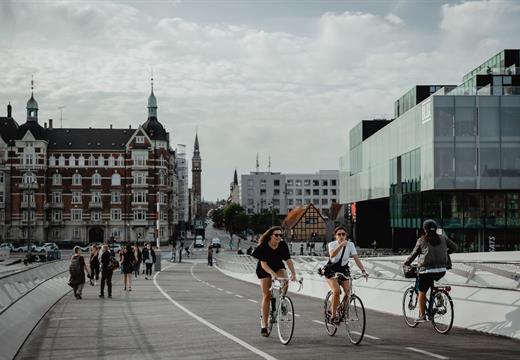
Philipp Cerny, transport policy consultant and chief executive editor of the EU Mobility Atlas, confirmed that mobility is not gender neutral. Referring to the claim that there is a difference between urban, peri-urban and rural transport, he mentioned Copenhagen with its bicycle highways, and the possibility to take bicycles on board of trains, which allows an easy combination of different modes. He thought that both sticks and carrots play a role in getting more people to use more public transport, cycle and walk, and that sticks could be applied more strongly to those who can afford to change their habits.
The speakers all expressed their aspiration to make cities more inclusive, by enabling more affordable, better connected and accessible public transport and active transport infrastructure. Positive changes are seen in many cities which are committed to the mobility transition. What is needed is financial, technical and strategic support from all levels of government.
The video of the session is available here.