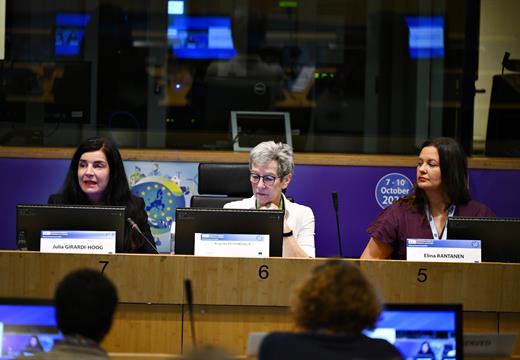
Greens' workshop on Gender-inclusivity in urban planning during the EU Regions Week
Cities have long been designed predominantly by men, often neglecting the needs of women* and non-binary people. This gender imbalance in urban planning has profound implications for daily life—from the way we navigate our cities, to the availability of walkable areas, public toilets, sports infrastructure, and even the names of streets. Yet, a more equitable and sustainable future is possible when we bring a feminist lens to the table. That is exactly what our workshop, ‘Gender-Inclusivity in Urban Planning and Design,’ organised during the EU Regions Week, aimed to achieve.
The workshop attracted over 65 in-person attendees, with additional participants joining online. Half of whom were local and regional government officials, while the others represented EU level and politicians, a reflection of the growing momentum for gender-sensitive planning.
The session was kicked off by a powerful intervention Julia Girardi-Hoog, head of the Department for Social Affairs and Service of the city of Vienna, who presented a compelling case for how public spaces often fail women*. Notably, she highlighted how women* in urban areas bear the brunt of climate change, which further exacerbates vulnerabilities and inequalities. Julia’s argument went beyond theory, as she showcased Vienna’s cutting-edge gender-sensitive initiatives that are setting new benchmarks for urban development. Her insights were eye-opening and a call for action for cities across Europe, providing clear principles to rethink and to adopt.
Following this, Elina Rantanen, Deputy Mayor of Turku, Finland, and a member of the Greens, emphasised the importance of gender-balanced representation in politics. She underscored how achieving a gender-balanced presence in decision-making circles transforms the political landscape, directly influencing gender-sensitive planning. Elina didn’t just stop at rhetoric; she laid out a blueprint for action, revealing how Turku has cracked the code on securing funding through participatory budgeting, turning citizens into active stakeholders in the policy process. Drawing on tangible successes from Turku, she painted a compelling picture of how inclusive planning isn’t just a buzzword—it’s a force for real, measurable change.
One of the key takeaways was that gender-inclusive urban planning benefits everyone—not only does it create spaces that enhance the quality of life for all, but it also empowers men to break away from traditional roles and become more active in family and social life.
Angelika Poth-Mögele, Secretary General of the Greens in the Committee of the Regions, steered the session with a dynamic touch. Designed as an interactive exchange, the session actively engaged participants through Slido polls, pushing them to confront the stark realities of gender-sensitive urban planning. As discussions unfolded, a series of entrenched obstacles came to light: the pervasive gender-blindness embedded in planning processes, the chronic underrepresentation of women in political decision-making, and the frustrating disregard for gender-inclusive planning, even when it proves to be a cost-effective solution. The session didn’t just identify these barriers—it sparked a deeper reflection on the urgent need to dismantle them.
The lively Q&A session that followed sparked a deeper discussion on how to overcome these obstacles, stressing the urgency for political commitment and cross-sector collaboration. Participants left the session inspired, with 91% expressing that they see real potential for implementing gender-inclusive changes in their own regions and municipalities.
This workshop was more than a conversation; it was a call to action. We now have the tools and inspiration to push for urban planning that works for everyone. The future is feminist, and it’s green.
The full session is available here European Committee of the Regions – #EURegionsWeek 2024: Cities for All – Gender-Inclusive Urban Planning and Design (smv.cloud).