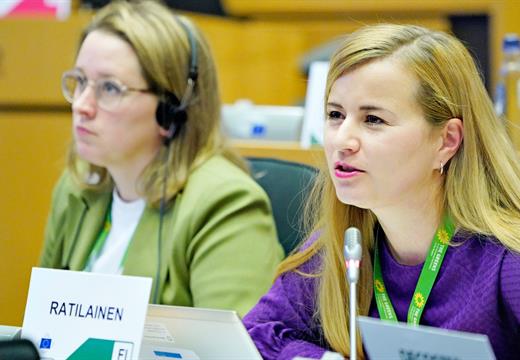
Niina Ratilainen speech on for fostering women's leadership in a changing world
On the occassion of International Women’s Day 2023, the European Committee of the Regions organised an event ‘From local to global: fostering women’s leadership in a changing world on 14 March 2023.’ The closing remarks were delivered by the co-president of the Greens in the CoR, Niina Ratilainen.
Niina Ratilainen, closing remarks:
‘Distinguished speakers, dear participants, dear fellow friends of gender equality. I have taken so many notes of our Conference and perhaps experienced the strongest feelings I ever have in this meeting room. Because the topic is so personal.
I am empowered to have participated this discussion and sharing of experiences from across Europe. On the other hand, I feel exhausted. Actually, I do not want to spend time as politician talking of women’s rights. I love to be here with you, while at the same time I would like to be preparing a speech on the Eastern Partnership and a statement on public finance and public debt.
But every year as a politician, I am becoming more involved in women’s rights and human rights, because as we have heard today, there are so many structural obstacles and sexism. The rights we have gained so far, are also being challenged. As politicians, we are the counter force to ideologies that want to reverse human rights of women in all their diversity. This is so important because when you think of any tyrants in undemocratic states, there is one thing they fear more than anything: girls and women who have freedom of choice! As vice-president of the European Parliament today said, ‘gender disparity is a democratic deficit’.
I do not want to go deeper into the justifications of why we need equality of all genders and equal representation of women. I think it is self-evident and it should not be women’s job to explain why we need to accelerate gender equality. We have heard today of the multiple layers involved in advancing gender equality, representation and proportionality of women in politics.
I am proud to have witnessed a four-year period, where the presidents of the five parties in the Finnish government were all women. I have seen young girls dress as a prime minister to a masquerade party – because they see themselves in news.
Representation on its own does not fix society of course. Only gender transformative politics do it.
On discrimination, exclusion, overlooking, repressing, stereotyping, gatekeeping. Harmful norms and toxic patterns, which are practiced both knowingly and unknowingly.
To reflect some notions that were raised by the speakers today:
It has been said many times today, that local & regional level is often the first stepping point for women in politics.
We have heard of positive development in legislation such as pay transparency and gender quota on company boards. Which proves the point that legislation is girls’ best friend.
We have heard of transhumanist philosophy. Disadvantages of sexism to mental health for women in politics. What online harassment and hate speech are doing to young women who consider whether to run for office. Practices to support female entrepreneurs, and women of Kharkiv who fight the unimaginable fight.
And what about the women with less privileged backgrounds or loss of their home country? This demonstrates how we need intersectionality and true diversity. We have to enhance equality of all women, not only women like ourselves.
And finally, the multiple crises we live in: there is no such thing as gender neutral policy. However, politics is still very often gender blind. That is why it is also necessary to think of the gender dimension is all policy areas and not address gender in just one file. Policies can either advance gender parity or cause a setback.
I have three important guidelines in life:
- only date feminists.
- in political events, where only men are invited to speak, always gracefully ask what this is about.
- raising and supporting each other.
This is the exact same advice I was given in my first city council meeting 11 years ago. The advice came from a member of a different political party, with who I more often disagree than agree with. I would like to conclude with this in our minds, because we all stand on shoulders of generations of female leaders who fought the fight. Likewise, we are working on it so that future generations do not have to.
The CoR President Vasco Alves Cordeiro was very vocal about the numbers of gender parity in the European institutions and local and regional politics. We have to change this – and we start from the places we are able to reach.
I hope that after this event there is time to chat, change contacts, form alliances. I will start myself, as co-president of the Greens in the CoR by inviting all female members of the CoR – less than 1 in 4 members -, as well as all friends of gender equality regardless of their own gender, to think of ways for the women of the next generations to stand on our shoulders in this building, in larger numbers.’: