Niina Ratilainen statement upon visit to Ukraine
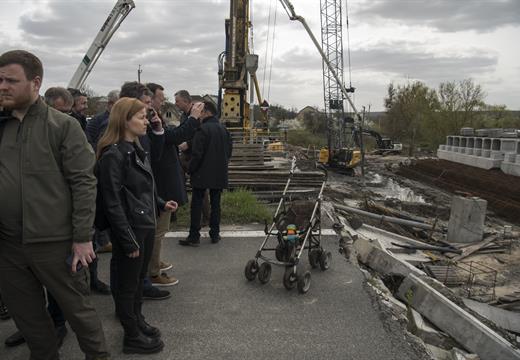
The Greens in the CoR Co-President Niina Ratilainen was in Ukraine this week as part of a delegation from the European Committee of the Regions (CoR). At the International Summit of Cities and Regions in Kyiv on 20 April, the CoR called for local democracy and good governance to be foundation stones of Ukraine’s reconstruction. On 19 April, the CoR delegation visited the towns of Irpin and Bucha, and the villages of Hostomel, Borodyanka, Andriivka, Makariv, and Dmytrivka, where they had an opportunity to see first-hand the damage wreaked in the region by the Russian invasion.
Niina Ratilainen, Co-President of the Greens in the European Committee of the Regions reflected:
‘Community is what keeps people together. The European Committee of the Regions has been active and strongly committed to react, support, follow up and answer the needs of the cities and regions in Ukraine. Nevertheless, we have learned so much during our mission in Ukraine. We have for example learned from Bucha, how after the liberation and with the leadership of mayor Fedorok, people started, immediately to clean up the city, attend the wounded, bury those who were lost and rebuild their beloved surroundings. It is indeed simply amazing, how swiftly reconstruction has taken place and new houses and schools have been built.
These days, I have been thinking, how in 1947 the president of Finland Juho Kusti Paasikivi wrote in his diary: “What will become of our lives”. Finland declined the Marshall plan and the European recovery programme, because of pressure from the Soviet Union. There had been heavy indemnities. I do not think this is the case in Ukraine. The support, commitment and cooperation has been tremendous. We rebuild together as international community. Perhaps similarity between these periods is that people and leaders of their communities step up.
But not only things we see with our own eyes need to be prioritised in reconstruction. I want to highlight transgenerational trauma. Trauma of war can continue as far as four generations which follow. This is where Finland failed in dire times of reconstruction and relocation of displaced people from lost regions. Times were different and we as humans are overall better equipped to understand the complexity and importance of mental recovery. In early war reconstruction, we also have to design social, psychological and mental aid. A generation of men return to their daily lives from war visibly fine but with shattered minds. Mental rehabilitation in short and long-term reconstruction is crucial. It is about professional support but also about communities’ awareness and responsiveness to the wellbeing of citizens. I think together we can facilitate a strong alliance of peer support in this perspective as well.
The cities and regions of the EU are committed to supporting Ukrainian cities and regions. Multilevel governance in recovery and reconstruction is needed and dialogue is the utmost key principle. Inclusiveness makes the results more sustainable. As local authorities are close to people and communities, they are able to include the whole spectrum of society. My grandmother hid from Soviet bombings as a three-year-old girl, in a shed with her mother and her favourite hen. In the last year, she has been so often worried about the Ukrainian girls facing the same fears. She was never able to return to her home after the war, because the border of Finland had been shifted. My grandmother and I both wish every day, that all the Ukrainian girls who fled, will be able to see their home and familiar cities and towns again. It is crucial to the recovery of people and their communities – and their full right.’